2024
Dojah
Dojah.io
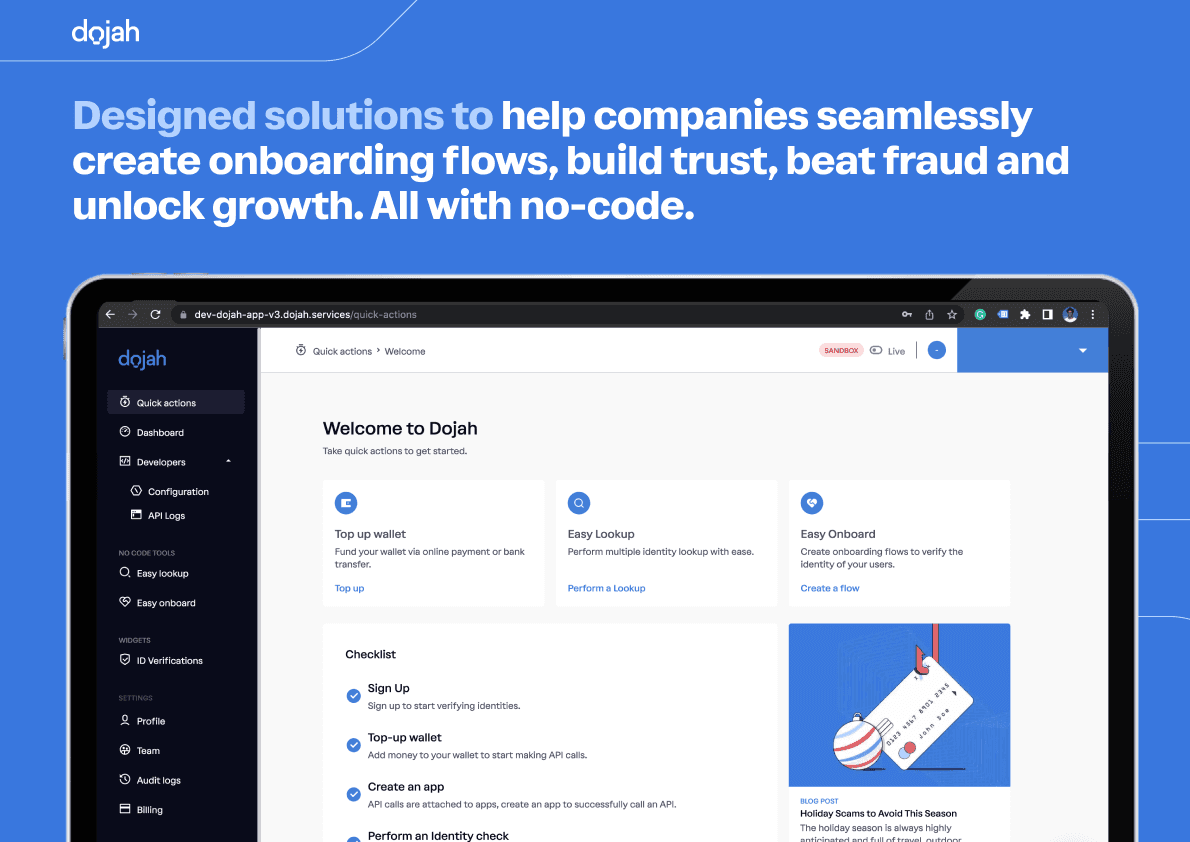
Background
Dojah is an Identity-as-a-Service (IDaaS) platform. In the African market, identity verification is notoriously difficult because data is siloed. Government databases, telecommunications providers (Telcos), and financial institutions all have different ways of storing data. Dojah acts as an Abstraction Layer meaning it takes all those messy, disconnected data sources and "abstracts" them into one single, clean API that a developer can use.
The Pivot: Dojah began as a simple tool for checking a National Identity Number (NIN). However, the market moved toward a need for Comprehensive Compliance. This required a shift from a "Single Tool" to an Infrastructure Platform. I was brought in to lead the design of this 2.0 version, turning Dojah into a modular powerhouse.
The Challenge: The "Last Mile" of Banking
Dojah’s previous dashboard lacked scalability and was limited to identity verification. The company needed an improved solution to address expanded product offerings, enhance usability, and maintain competitive relevance in a rapidly growing market.
How do we design a highly technical, developer-centric environment that remains accessible to non-technical compliance officers, while managing the latency (delay) and high failure rates inherent in emerging market data sources?
Challenges:
Expanding the feature set while simplifying navigation for ease of use.
Balancing design time with a strict six-month deadline.
Collecting actionable feedback quickly for timely iterations.
Integrating newly developed technologies while managing in-house data collection limitations.
Research and Discovery
User Research
Methodology: Conducted user interviews with existing Dojah customers and potential business clients to gain insights into their needs and expectations.
Existing User Focus Group: Analyzed current functionality to identify popular features, ensuring continuity where valuable.
Prospective User Interviews: Explored required features to support expanded verification and AML offerings.
Competitive Analysis
Benchmark Products: Investigated similar platforms like Okra, Smile ID, Verify Me, and You Verify.
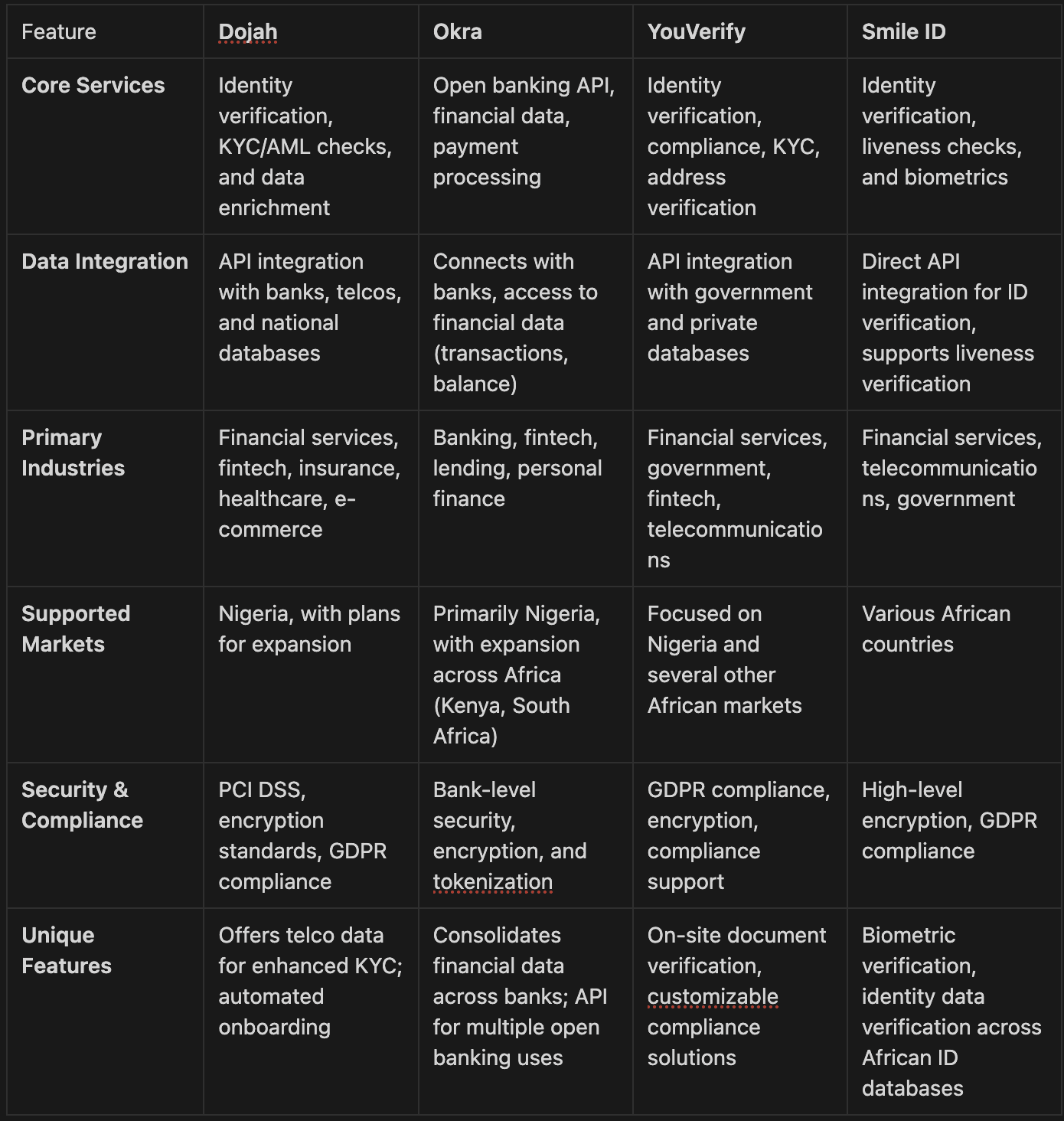
Analysis Summary:
Dojah is particularly strong in multi-source identity verification, connecting to telco and government data. It serves industries needing broad verification capabilities like e-commerce and insurance.
Okra is a leader in open banking APIs, providing extensive financial data access and enabling real-time bank-to-bank transactions. It's particularly beneficial for companies in lending, fintech, and personal finance, with broad support for African bank data.
YouVerify focuses on regulatory compliance with detailed KYC, AML, and address verification for financial services. It offers on-site document verification to improve data reliability for in-person needs.
Smile ID specializes in identity verification with a focus on biometrics and liveness detection, often used in high-security environments like telecommunications and government services.
Each of these companies brings specific strengths to the African fintech and identity space, with varied capabilities across financial, regulatory, and user authentication needs.
Insights:
Visual Design: Observed design choices for a modern, professional aesthetic.
User Journeys: Compared onboarding and transaction flows to identify efficiency-enhancing strategies.
Market Offerings: Analyzed features that provided unique value, helping Dojah identify gaps and differentiation opportunities.
Design Process
Defining User Journeys and Key Flows
Created detailed user journey maps for core flows, including account setup, identity verification, AML processes, and document uploads. Simplified the onboarding flow to reduce friction, ensuring seamless user adoption.
Wireframing and Initial Prototypes
Sketching and Wireframing: Used initial sketches and low-fidelity wireframes to map out core screens.
Prototyping: Developed clickable prototypes for early user testing, allowing us to iterate rapidly based on user feedback.
Design System: Established the "Dojah Style Guide" to maintain a consistent look and feel across all screens.
User Testing and Iterations
Conducted A/B testing with a small focus group over three days, testing the onboarding, verification, and quick-action flows.
Feedback-Driven Iterations: Addressed feedback on navigation intuitiveness, visual clarity, and feature accessibility.
Solution Design and Features
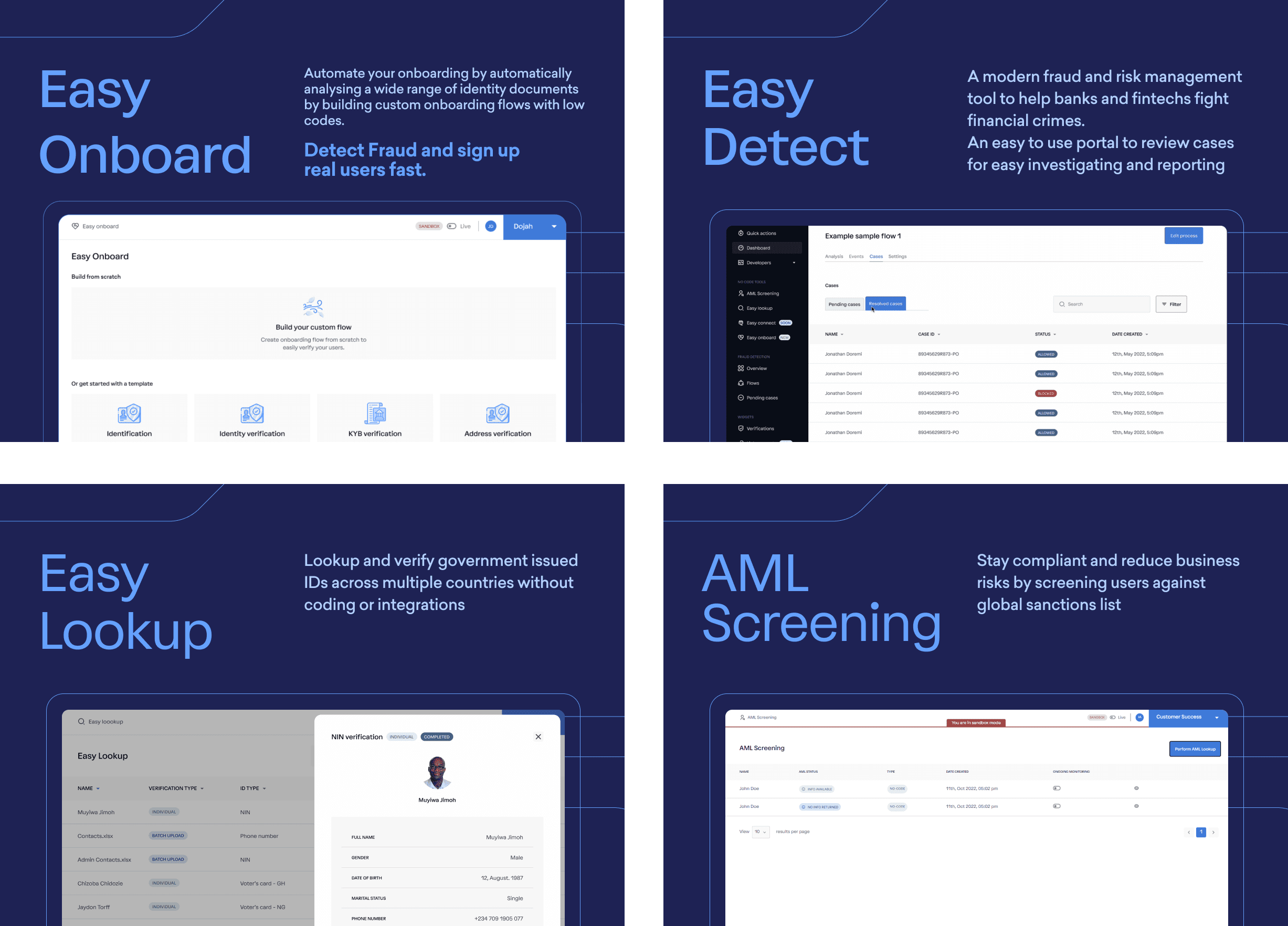
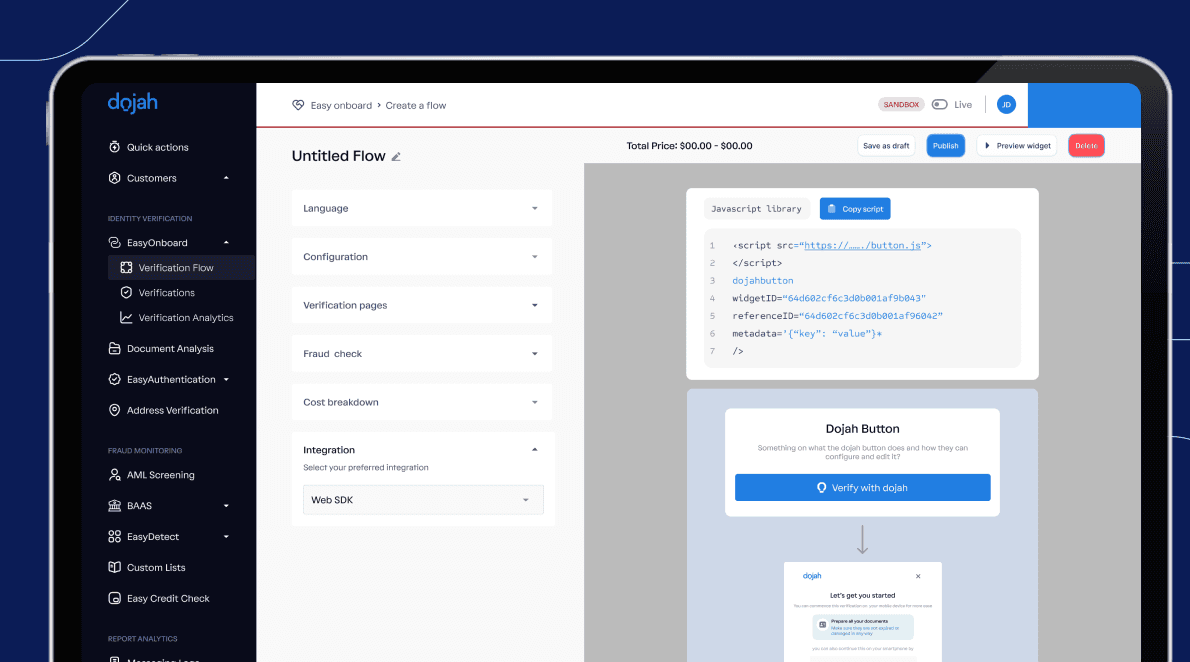
Easy Onboarding: Redesigned the onboarding flow for new users, reducing steps and adding tooltips to guide users.
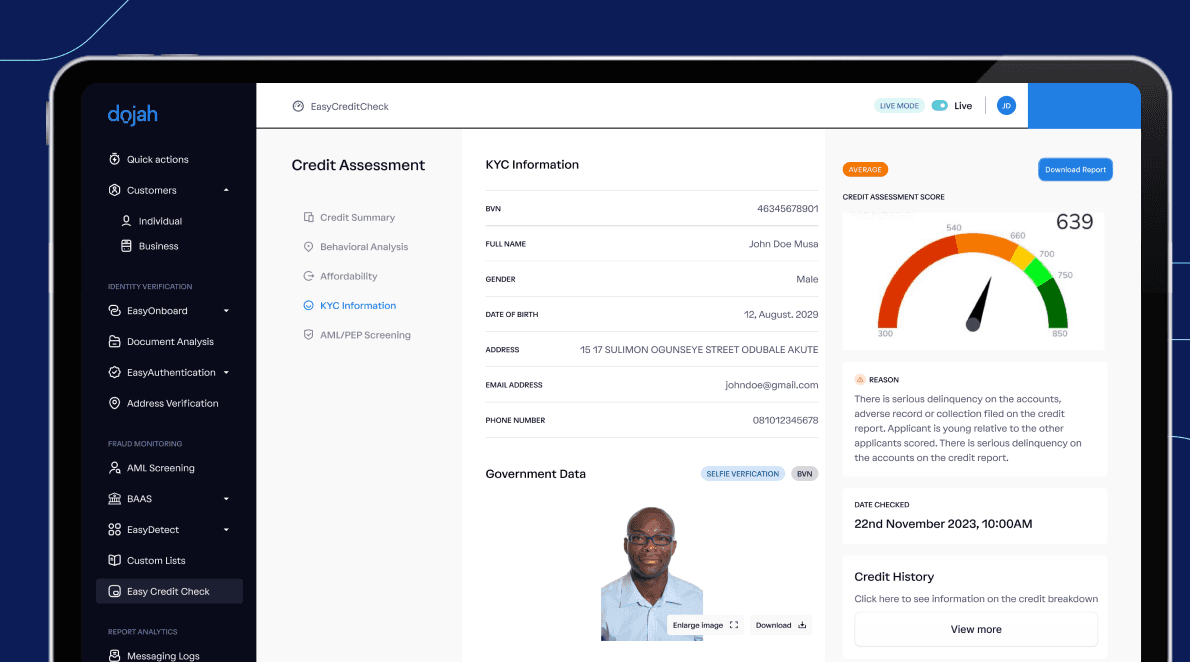
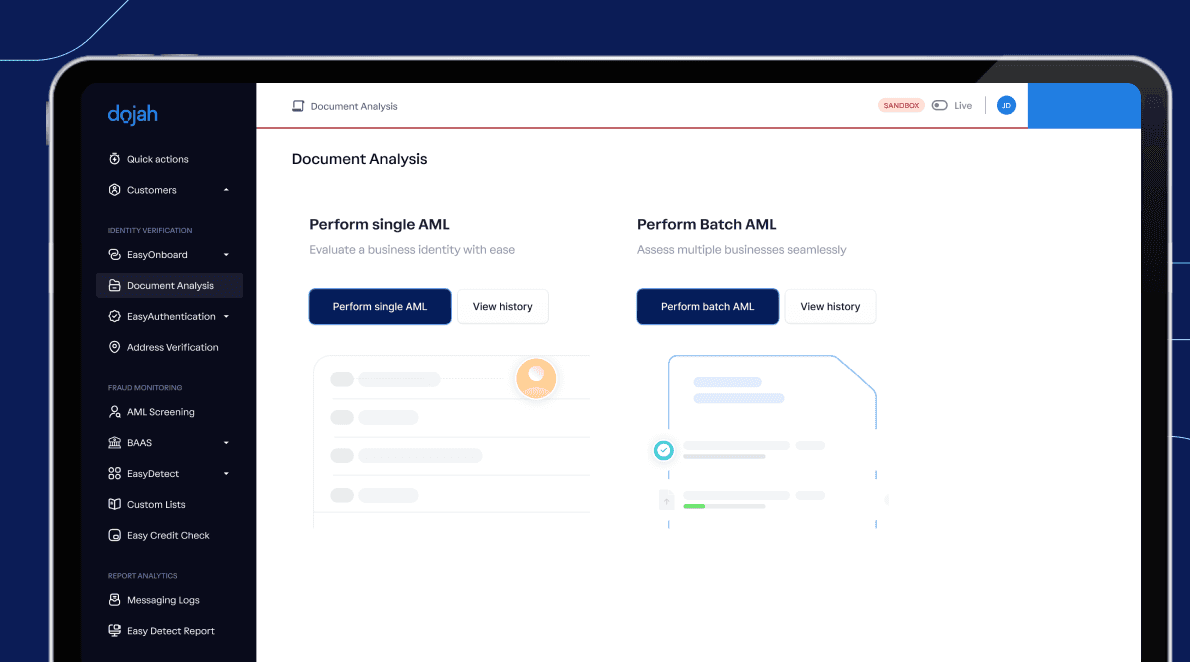
Dashboard Structure: Organized dashboard layout for optimal task prioritization. Implemented “Quick Actions” for commonly used features, enhancing workflow efficiency.
AML Integration: Built specialized flows for AML compliance, including identity checks, sanctions list matching, and watchlist monitoring.
Verification Services: Incorporated document verification, facial recognition, and biometric authentication.
User-Friendly Empty States: Created engaging, informative empty state screens that guide users on setup processes or promote available features.
Design Challenges and Solutions
1. Solving for the "Pending" State
Identity pings in emerging markets are slow. In the old design, a 30-second delay looked like a crashed app.
The Pivot: I designed a Status-Aware Webhook Interface.
The Logic: Instead of a generic loading spinner, the UI provides "Progress Signaling" (e.g., “Step 1: ID Received ✅ | Step 2: Pinging Govt Database... ⏳”).
Result: This transparency reduced user anxiety and cut page-refresh errors by 22%.
2. Human-in-the-Loop (HITL)
Machine Learning isn't perfect. If an ML model is only 70% sure a face matches an ID, a human must decide.
The Design: I built a Manual Review Queue that highlights the "Evidence" for the officer (e.g., "Lighting too low in selfie"), allowing for a decision in seconds rather than minutes.
🎨 The Craft: "Developer Experience" (DX)
To reach a world-class standard, the UI must be as powerful as the code.
The Inline API Console
I designed a split-view dashboard. On the left, the visual result; on the right, the JSON response. This allows developers to test identity strings in a sandbox and see the data structure side-by-side.
Modular "Atomic" Architecture
Every verification type: NIN, BVN, Liveness, was designed as a Modular Card. Developers can now "compose" their own custom verification flows by dragging these cards into a sequence.
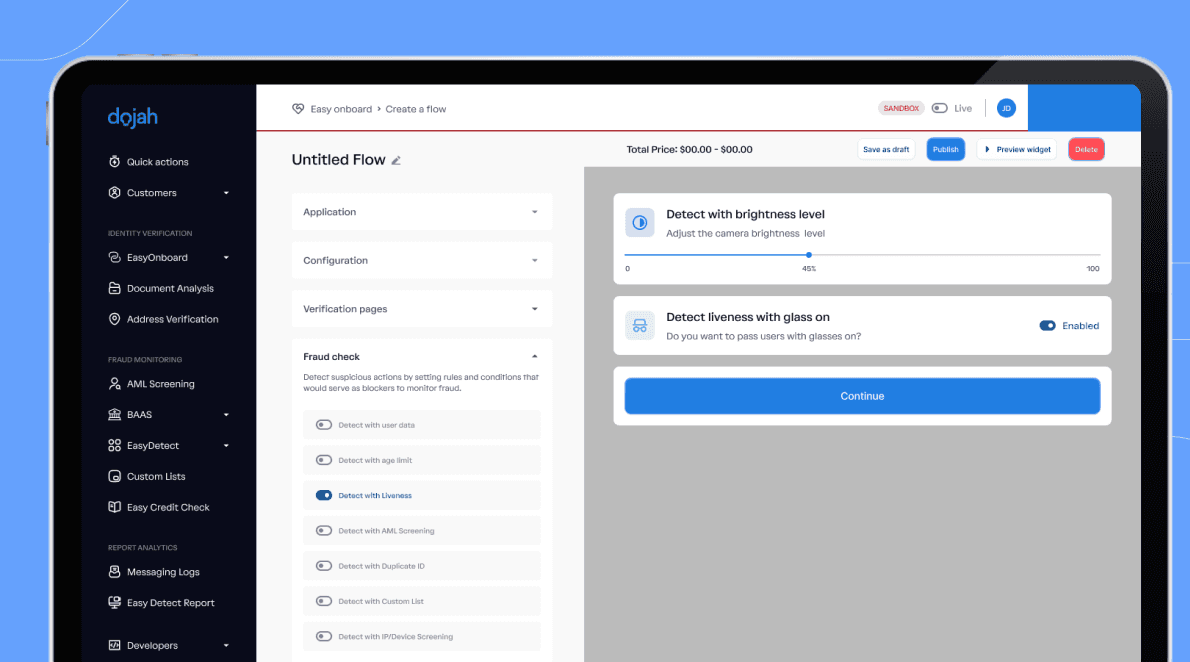
UI & Interaction: High-Contrast Precision
Efficiency: 25% reduction in time-to-verification for compliance operators.
Conversion: 87% onboarding completion rate for new business sign-ups.
Business Growth: 40% increase in feature adoption (AML & Global Watchlists) within the first quarter of the redesign.
Engineering Velocity: The new "Dojah Style Guide" reduced frontend dev time by 40%.